

Schengen visa requirements depend on the passport you hold, the purpose of your visit and your individual circumstances. The Schengen Area allows visitors to travel between participating European countries without routine checks at internal borders, but not everyone is eligible to enter visa free.
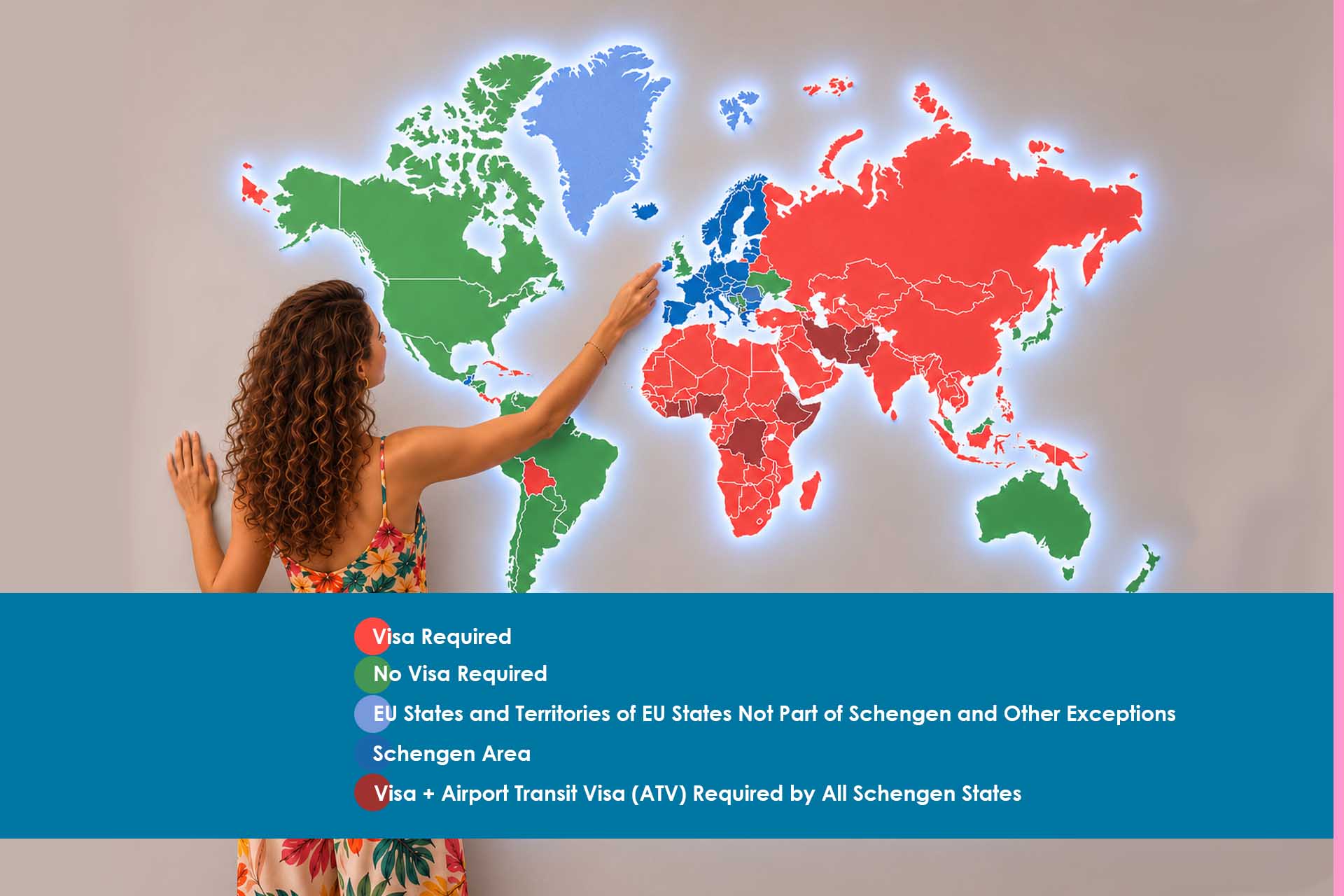
Travellers holding passports from countries outside the Schengen visa exempt list, including India, Russia and South Africa, generally need a Schengen visa for short visits. Foreign nationals living in the UAE, UK or USA may also need one, depending on their nationality, even if they are legally resident in those countries.
What Is a Schengen Visa?
A Schengen visa is a short stay visa that allows eligible non-EU nationals to visit the Schengen Area for up to 90 days within any 180-day period.
The Schengen Area currently comprises 29 European countries, including France, Germany, Italy, Spain, Portugal, Switzerland and the Netherlands.
Bulgaria and Romania became full Schengen members in January 2025. Ireland is not part of the Schengen Area, while Cyprus has not yet fully joined.
A uniform Schengen visa generally permits travel between participating countries, subject to its validity and the applicable entry requirements.
Schengen Visa Requirements by Nationality
Whether you need a Schengen visa depends on your nationality and the passport you intend to use. The European Union maintains a list of countries whose nationals require a visa and a separate list of countries whose nationals are exempt from the short-stay visa requirement.
For example:
| Passport nationality | General short-stay visa requirement |
| Indian | Visa generally required |
| Russian | Visa generally required |
| South African | Visa generally required |
| Emirati (UAE) | Visa generally not required |
| British | Visa generally not required |
| American (US) | Visa generally not required |
These requirements relate to nationality, not simply where a person lives.
For example, an Indian national legally residing in Dubai will generally need a Schengen visa to visit France. A UAE national living in Dubai will generally be able to visit France without a short-stay visa.
Similarly, a British citizen living in the USA generally does not need a Schengen visa for a short visit, while an Indian citizen living in the USA generally does.
The rules can differ for certain passport types, residence permits and travel purposes. Further guidance is available on the official European Commission visa policy guidance page.
Types of Schengen Visa
The appropriate visa depends on the purpose and duration of your journey.
Short-Stay Visa (Type C)
A Type C visa is generally used for visits of up to 90 days within any 180-day period.
The visa may be issued as a single entry, double entry or multiple entry visa. A multiple entry visa may allow several visits during its validity period, but the 90-day limit generally continues to apply.
Permitted purposes may include:
- Tourism and holidays.
- Visiting family members or friends.
- Business meetings and conferences.
- Certain short-term training activities.
- Medical treatment.
- Cultural or sporting events.
Airport Transit Visa (Type A)
Some travellers require an airport transit visa when changing flights at an airport within the Schengen Area. This generally permits transit through the international transit area of an airport. It does not allow the holder to enter the Schengen country itself.
Whether an airport transit visa is required depends on nationality, the airport and the circumstances of the journey.
National Long-Stay Visa (Type D)
A Schengen short-stay visa is not suitable for someone intending to live, work or study in a European country for an extended period.
For stays exceeding 90 days, applicants will generally need to consider the relevant national visa or residence permit.
The requirements differ between countries.
Understanding the Schengen 90 / 180-Day Rule
The 90 / 180-day rule is a central requirement governing short stays in the Schengen Area. Under the Schengen Borders Code, nationals of countries exempt from the short stay-visa requirement, as well as visitors holding a short-stay Schengen visa, may stay for a maximum of 90 days within any rolling 180-day period, subject to the conditions of their admission.
The 90-day allowance applies across the Schengen Area as a whole, not separately to each country. Time spent in France, Italy, Spain or any other Schengen country counts towards the same overall limit.
For example, if you spend:
- 30 days in France;
- 30 days in Italy; and
- 30 days in Spain;
you will have used your full 90-day short-stay allowance. Moving between Schengen countries does not restart the permitted period or provide an additional allowance.
The 180-day reference period is not a fixed six-month window. It is a rolling period, meaning that the 180 days immediately preceding each day of the stay must be considered when calculating the permitted duration. Both the date of arrival and the date of departure count as days spent in the Schengen Area.
Travellers making frequent visits should therefore keep an accurate record of their entry and exit dates. The European Commission provides an official Schengen short-stay calculator to help calculate previous stays and plan future travel.
Where Can You Apply for a Schengen Visa?
You do not need to live in Europe to apply for a Schengen visa. Applications are generally submitted to the relevant consulate or authorised visa application centre in the country where you are legally resident.
For example, an Indian national living in India would generally apply there, while an Indian national legally residing in the UAE or USA would normally apply in their country of residence.
Your nationality determines whether you need a visa; your country of legal residence generally determines where you apply.
If you are temporarily visiting a country where you are not resident, you may only be able to apply there in exceptional circumstances, where you can justify doing so.
Which Schengen Country Should You Apply To?
If you plan to visit several Schengen countries, you must apply through the consulate responsible for your main destination. This is generally:
- One country: Apply to that country’s consulate.
- Several countries: Apply to the country where you will spend the longest period.
- Equal stays: Apply to the country you intend to enter first.
For example, if you plan to spend five days in France and three days in Italy, France would generally be responsible for processing your application.
The main destination may also be determined by the principal purpose of your visit, as explained in the European Commission’s Schengen visa application guidance. Your application should therefore reflect your genuine travel plans, rather than being directed to a consulate simply because it offers a more convenient appointment.
Schengen Visa Requirements
Although individual consulates may have different document checklists, applicants will generally need to provide the following.
1. Valid Passport
Your passport must meet the relevant validity requirements.
As a general rule, it must:
- Have been issued within the previous 10 years.
- Remain valid for at least three months after your intended departure from the Schengen Area.
Applicants should check the specific requirements of their destination country before applying or consult legal advice.
2. Application Form and Photograph
Applicants must complete the relevant visa application form and provide a photograph that meets the applicable requirements.
The information should be accurate and consistent with the supporting documents.
3. Evidence of Financial Means
Applicants must demonstrate that they can cover the costs of their intended visit.
Evidence may include:
- Recent bank statements.
- Payslips.
- Employment confirmation.
- Evidence of savings.
- Sponsorship documents, where applicable.
The amount required depends on the destination country, the length of the visit and the proposed accommodation arrangements.
There is no single financial threshold that applies identically to every Schengen country.
4. Travel Medical Insurance
Travel medical insurance is generally required for a Schengen visa application.
The insurance must usually provide at least €30,000 in medical coverage and include emergency medical treatment, hospitalisation and repatriation.
It must also be valid throughout the Schengen Area and cover the intended period of travel.
5. Travel and Accommodation Evidence
Applicants may need to provide evidence of their intended travel arrangements, including:
- Flight reservations or itinerary.
- Hotel bookings or accommodation details.
- An invitation letter, where relevant.
- Details of the purpose of the visit.
The consulate may request additional evidence depending on the applicant’s circumstances.
How to Apply for a Schengen Visa
The application process generally involves six steps:
Step 1: Identify the Correct Consulate
Determine which Schengen country is responsible for your application and check its official requirements.
Step 2: Complete the Application Form
Provide accurate information consistent with your supporting documents.
Step 3: Book an Appointment
Check whether applications are submitted directly to the consulate or through an authorised visa application centre, such as VFS Global, TLScontact or BLS International.
Step 4: Prepare Your Documents
Follow the relevant consulate’s checklist and provide evidence supporting your travel purpose and eligibility.
Step 5: Attend Your Appointment
Submit your application, provide biometric information where required and pay the applicable fees. Certain applicants may be exempt from fingerprint collection.
Step 6: Await the Decision
The consulate will assess your application against the applicable visa requirements. Avoid making non-refundable travel arrangements before your visa is issued.
Schengen Visa Fees and Processing Times
The standard Schengen visa fees are generally:
| Applicant | Standard visa fee |
| Adults | € 90 |
| Children aged 6 to under 12 | € 45 |
| Children under 6 | Generally free |
- Certain applicants may qualify for fee exemptions or reduced fees.
- Visa application centres may also charge an additional service fee.
- The normal processing period is approximately 15 calendar days. However, processing may take up to 45 days where further examination or additional documents are required.
- Applicants should generally submit their application no earlier than six months before their intended journey and at least 15 days before departure.
- Applying well in advance is advisable, particularly during busy travel periods.
Common Schengen Visa Refusal Reasons
A Schengen visa application may be refused if the applicant does not satisfy the relevant requirements.
Common issues include:
- Insufficient evidence of financial means.
- An unclear or inadequately supported purpose of travel.
- Inconsistent information in the application.
- Concerns about the applicant’s intention to leave the Schengen Area.
- Inadequate travel medical insurance.
- Missing or unreliable supporting documents.
A refusal does not necessarily mean that an applicant will never qualify for a Schengen visa. The refusal notice should explain the reasons for the decision and provide information about the available appeal procedure.
Applicants should carefully review the refusal reasons before deciding whether to submit a new application or pursue an appeal.
EES and ETIAS: What Travellers Should Know
European border procedures are changing.
The Entry/Exit System (EES) is a digital system that records the entry and exit of eligible non-EU nationals travelling to the Schengen Area for short stays. It also records relevant biometric information.
The European Travel Information and Authorisation System (ETIAS) is a separate travel authorisation system for nationals of countries that do not require a short-stay visa.
Neither system replaces a Schengen visa where one is required.
Applicants should check the latest official information before travelling, particularly where their nationality or residence status affects the applicable requirements.
Further information is available through the European Commission’s EES and ETIAS guidance.
EES and ETIAS: What Travellers Should Know
The EU has introduced new digital border procedures for international travellers.
The Entry / Exit System (EES) has been fully operational since 10 April 2026. It records the entry and exit of eligible non-EU nationals visiting the Schengen Area for short stays, including biometric information.
The European Travel Information and Authorisation System (ETIAS) is not yet operational. Once introduced, it will require eligible visa-exempt travellers to obtain travel authorisation before visiting participating European countries.
Neither system replaces a Schengen visa where one is required. Travellers should check the latest European Commission guidance on EES and ETIAS before travelling.
How Mulgrave Law Can Help with Your Schengen Visa Application
Schengen visa applications involve detailed documentation and strict requirements to follow. Professional advice can be particularly valuable if your financial circumstances are complex, such as for self-employed applicants, freelancers or those with previous refusals.
At Mulgrave Law, we provide independent Schengen visa advice and application assistance. We can help you complete a well support application by:
- Reviewing application forms and supporting documents to identify inconsistencies or omissions.
- Present financial evidence clearly and appropriately.
- Understand the reasons for a previous refusal and explore available options for challenging the decision.
Book a consultation to discuss your Schengen visa application.
-
- Phone: +44 20 7253 7248
- Email: info@mulgravelaw.co.uk
- Contact form
Schengen Visa Requirements: Frequently Asked Questions
1. Do I need a Schengen visa if I live outside Europe?
It depends on your nationality. Schengen visa requirements are primarily determined by the passport you hold, not your country of residence.
2. Can I apply for a Schengen visa from the UAE?
Yes. If you are legally resident in the UAE and your nationality requires a Schengen visa, you can generally apply through the relevant consulate or authorised visa application centre in the UAE.
3. Can I apply for a Schengen visa from the USA?
Yes. Applicants legally resident in the USA can generally submit their application through the relevant Schengen country’s consulate or authorised visa application centre.