

If you are applying for a UK Spouse Visa but have never lived with your partner, you can still qualify. Married couples do not generally need to have lived together before applying, but they must meet the applicable relationship requirements, which generally include having met in person.
If you have never met face to face, or your marriage took place by proxy, seek advice on how the rules apply to your circumstances before applying.
You should explain why you have never lived together and provide relevant evidence of your relationship. You must also meet the other applicable visa requirements, including the financial, English language and accommodation requirements.
Key Points
- Married couples do not generally need to have lived together before applying for a UK Spouse Visa.
- You must have met in person and be in a genuine and subsisting marriage.
- You must intend to live together permanently in the UK.
- Explain why you have lived apart and provide relevant relationship evidence.
- You must meet the other applicable visa requirements.
Does the Home Office Require Couples to Have Lived Together?
The Immigration Rules do not generally require married couples to have lived together before applying for a UK Spouse Visa.
The absence of a shared address does not automatically mean that a marriage is not genuine. The Home Office considers the circumstances of the relationship and the evidence provided.
However, little or no history of living together may prompt further scrutiny in some cases. The case worker may consider why you have lived apart, how your relationship has developed and how you have maintained your commitment to each other.
Cultural or religious practices may also be relevant, particularly where couples traditionally begin living together only after marriage. The Home Office’s guidance on assessing partner relationships recognises that relationships develop differently depending on individual circumstances and cultural traditions.
Why Have You Never Lived Together?
If you and your partner have never shared a home, explain the reasons in your application and provide supporting evidence where available. Your explanation should be factual, consistent with your documents and specific to your circumstances.
You Married Recently
If you apply shortly after your wedding, your partner may still be living overseas while you wait for the visa decision. Living apart after marriage is not, in itself, a reason for refusal.
Explain your circumstances and provide relevant evidence, such as your marriage certificate, records of visits, communication since the wedding and plans to establish a home together in the UK.
You Followed Cultural or Religious Traditions
Some couples do not live together before marriage because of cultural or religious traditions. An arranged marriage or limited contact before the wedding does not automatically mean that the relationship is not genuine.
Explain how these traditions affected your circumstances. Describe how the marriage was arranged, when you met, how your relationship developed and how you have maintained contact since the wedding.
Where available, you could provide wedding records, photographs, communication history or statements from family members who have direct knowledge of the relationship. In an arranged marriage, it is important to show that both partners consented to the marriage and agree to their plans for the future.
You Live in Different Countries Because of Work or Family Commitments
Work, business or caring responsibilities may prevent you from living in the same country before the visa is granted. Explain why you cannot currently live together and how you have maintained your relationship.
Relevant evidence may include an employer’s letter, business records or documents confirming caring responsibilities. Travel records, selected messages and call logs may also help demonstrate continued contact.
Explain your plans to establish a home together in the UK and, where relevant, why this cannot happen until the visa is granted.
You Have Faced Travel or Visa Restrictions
Visa refusals, entry restrictions or financial difficulties may have prevented you from visiting each other. Explain what prevented travel, when the restrictions applied and how they affected your ability to meet. If a visa was refused, explain the circumstances and provide the refusal letter where relevant.
Evidence may include:
- Relevant immigration correspondence or evidence of travel restrictions.
- Cancelled flight bookings or travel itineraries.
- Evidence of financial circumstances where travel costs prevented visits.
- Messages, emails or call records showing continued contact.
If there have been long gaps between visits, explain the reasons and support your account with relevant documents where available.
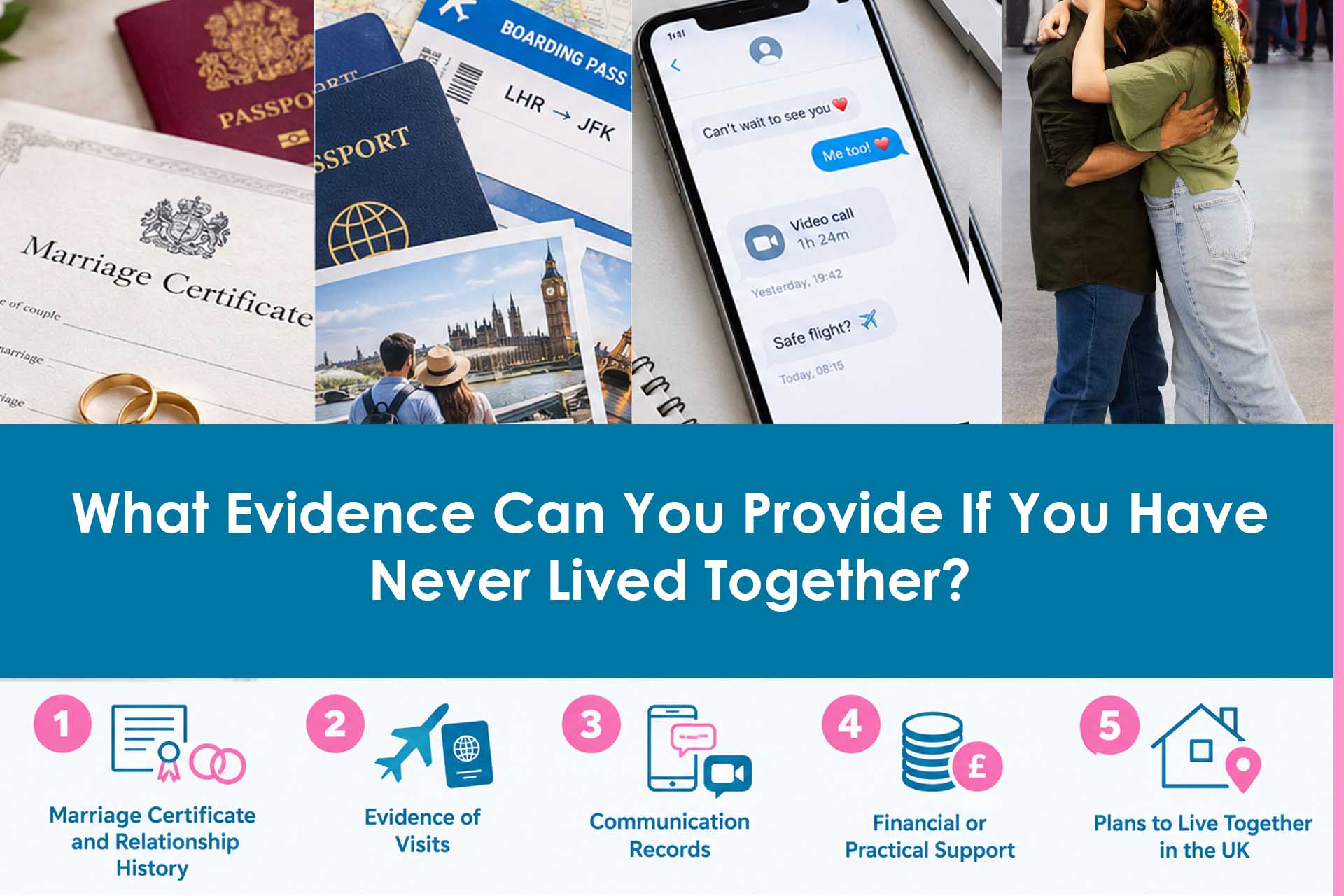
What Evidence Can You Provide If You Have Never Lived Together?
Evidence should reflect your circumstances and demonstrate that your relationship is genuine and continuing. You do not need to create joint bills or tenancy agreements if you have never shared a home.
1. Marriage Certificate and Relationship History
Provide your marriage certificate and a clear account of how your relationship developed, when you met, why you have lived apart and your plans to live together in the UK.
Check that the dates in your account are consistent with your application and supporting documents. Documents that are not in English or Welsh must be accompanied by a full translation that meets the Home Office’s requirements.
2. Evidence of Visits
If you have met in person, relevant evidence may include:
- Flight bookings, boarding passes or passport stamps.
- Hotel bookings or travel itineraries.
- A selection of dated photographs together.
- Evidence of attending weddings, family gatherings or other significant events.
Choose evidence that supports your relationship history rather than submitting large numbers of similar photographs or documents.
3. Communication Records
Selected messages, call logs, video-call records and emails can help demonstrate how you have maintained your relationship while living apart.
Choose records from different periods of the relationship. They should support the timeline you describe and help explain any significant gaps in contact.
4. Financial or Practical Support
Where relevant, include evidence of money transfers, contributions to travel or wedding costs, shared responsibilities or support provided to one another.
Joint bank accounts are not essential in every case, and financial support is not compulsory evidence in every application. The evidence should reflect how your relationship works in practice.
5. Plans to Live Together in the UK
Explain where and how you intend to establish a home together. If available, include accommodation documents, correspondence about moving arrangements or other practical preparations.
Distinguish confirmed arrangements from plans that have not yet been finalised.
Tip: Keep your evidence relevant, genuine and consistent. A well-organised selection of documents, supported by a clear explanation, is more useful than a large volume of repetitive material.
For broader advice, read our guide to proving a genuine and subsisting relationship for a UK Spouse Visa application.
How Should You Explain Why You Have Never Lived Together?
A relationship statement or cover letter can help the Home Office understand your circumstances and identify the relevant supporting documents.
Your explanation should cover four key points:
- Your relationship history:
How you met, how the relationship developed and when you married. - Your living arrangements:
Where each of you has lived and why you have not shared a home. - Your ongoing commitment:
How you have maintained the relationship through visits, communication and shared responsibilities, where applicable. - Your plans for the UK:
How you intend to establish a home and live together permanently.
Be factual and specific. If you have lived apart for several years, explain the reasons for the arrangement over that period rather than simply stating that distance made living together difficult.
Tip: Your statement should support, not replace, relevant documentary evidence. Make sure its details are consistent with your application and the documents you provide.
Will the Home Office Suspect Your Marriage Is Not Genuine?
Not having lived together does not, by itself, mean that the Home Office will consider your marriage non-genuine. However, little or no history of cohabitation may prompt further scrutiny in some circumstances.
Questions may arise if your relationship history contains unexplained inconsistencies, important dates do not match or the evidence does not adequately explain a prolonged period of separation.
Depending on the circumstances, the Home Office may request further information or arrange an interview to assess your relationship.
Check that your application form, relationship statement and supporting documents are consistent. If there is a genuine reason for an unusual circumstance, explain it clearly and provide supporting evidence where available.
You do not need to create evidence of cohabitation that never happened. A truthful explanation supported by relevant documents is preferable to an account that does not reflect your circumstances.
What If You Are Not Married and Have Never Lived Together?
The rules differ if you are applying as an unmarried partner rather than as a spouse. Under the UK Family Visa partner route, you generally need to show that your relationship has been similar to a marriage or civil partnership for at least two years before applying.
You do not necessarily have to have lived together during that period. The rules also recognise that some couples cannot live together, for example because of work, study or cultural circumstances. If you have never shared a home, explain why you have lived apart and provide evidence that your relationship is genuine and continuing.
The decision-maker will assess your circumstances against the applicable requirements. Meeting the two-year relationship requirement does not automatically guarantee that your application will be approved.
If you are engaged and intend to marry or enter into a civil partnership in the UK, the fiancé(e) or proposed civil partner route may be more appropriate. This route has separate requirements, including an intention to marry or enter into a civil partnership within six months of arrival.
Before applying, check the current UK Family Visa requirements for partners and spouses to ensure you choose the appropriate route and understand its eligibility and evidence requirements.
Common Mistakes to Avoid
When applying for a UK Spouse Visa without having lived together, avoid these common mistakes.
- Assuming a marriage certificate is enough.
It confirms that you are married, but you must also provide evidence that your relationship is genuine and continuing. - Submitting communication records without context.
Select relevant messages and call records from different periods and ensure they support the relationship history in your application. - Failing to explain long periods apart.
If you have lived in separate countries for an extended period, explain why and how you have maintained your relationship. - Providing inconsistent information.
Check names, dates, addresses, travel history and relationship milestones across your application and supporting documents. - Trying to demonstrate cohabitation that never happened.
You do not need to provide joint bills or tenancy agreements if you have never shared a home. Focus on evidence relevant to your circumstances. - Overlooking the other visa requirements.
Proving that your relationship is genuine is only one part of the application. You must also meet the applicable financial, English language and accommodation requirements.
For more information about wider eligibility issues, read our guide to UK Spouse Visa eligibility.
Frequently Asked Questions
1. Can I apply for a UK Spouse Visa immediately after getting married?
You may apply shortly after your wedding if you meet the relevant requirements. There is no general minimum period for which married couples must live together before applying.
2. Do we need joint bank accounts or bills to prove our relationship?
No. These documents are not compulsory in every case. If you have never lived together, you can provide other relevant evidence, such as communication records, travel documents, photographs and details of your relationship history.
3. Do we have to have met in person before applying?
Yes. The applicable partner requirements generally require you and your partner to have met in person. If you have never met face to face, seek advice on your eligibility before applying.
4. Can an arranged marriage qualify for a UK Spouse Visa?
An arranged marriage can qualify if it meets the relevant requirements. Cultural or religious traditions may help explain why you have not lived together, but you must still demonstrate that your relationship is genuine and subsisting.
5. Could my application be refused because we have never lived together?
Not simply because you have never shared a home. However, your application may be refused if you do not meet the relevant requirements or the evidence does not satisfy the decision-maker that your relationship is genuine and subsisting.
Glossary of Terms
| Term | Meaning |
| UK Spouse Visa | A visa that allows an eligible person to join or remain with their British or settled spouse in the UK, subject to the applicable requirements. |
| Genuine and subsisting relationship | A real relationship that continues to exist and meets the relevant immigration requirements. |
| Cohabitation | Living together in the same home. Married couples do not generally need to prove prior cohabitation to qualify for a Spouse Visa. |
| Arranged marriage | A marriage in which families or others may help introduce or select partners. It can qualify for a UK Spouse Visa if the marriage and relationship meet the relevant requirements. |
| Relationship statement | A written account explaining how the relationship developed, why the couple has lived apart and their plans to live together. |
| Financial requirement | The applicable rules on income, savings or other permitted financial evidence that must be met for the visa application. |
| Adequate accommodation | Accommodation that meets the relevant immigration requirements, including rules concerning overcrowding. |
| Unmarried partner | A partner who is not married to or in a civil partnership with their partner and who meets the applicable relationship requirements. |
| Fiancé(e) visa | A family visa route for an eligible person intending to marry or enter into a civil partnership in the UK within six months of arrival. |
Contact Mulgrave Law for Help with Your UK Spouse Visa Application
If you are married but have never lived with your partner, preparing your application may require careful consideration of your relationship history and the evidence available.
At Mulgrave Law, we assist individuals and couples with UK Spouse Visa and family immigration applications. We review your circumstances, identify relevant evidence, help address gaps or inconsistencies, and advise on the applicable immigration requirements.
-
- Phone: +44 20 7253 7248
- Email: info@mulgravelaw.co.uk
- Contact form