

Adequate Maintenance for UK Spouse Visas: Key Points at a Glance
If your British or settled partner receives certain disability-related or carer benefits, you may not need to meet the standard £29,000 spouse visa financial requirement.
Instead, your application may be assessed under the adequate maintenance provisions in Appendix FM of the Immigration Rules.
- The adequate maintenance route applies mainly where the sponsoring partner receives specified benefits recognised under Appendix FM.
- There is no fixed annual income threshold under this route.
- UK Visas and Immigration (UKVI) assesses whether the household has the required level of income.
- The weekly income must be equal to or higher than the amount of Income Support that would be available to a comparable British family.
- Applicants must still meet all other spouse visa requirements, including relationship, English language, accommodation and suitability requirements.
- Correct financial evidence under Appendix FM-SE is essential because applications can be refused due to missing or inconsistent documents.
If you are unsure whether adequate maintenance applies to your circumstances, immigration lawyers at Mulgrave Law can review your financial position and supporting evidence before you submit your application.
What Is Adequate Maintenance for a UK Spouse Visa?
The adequate maintenance test is an alternative financial assessment used for certain UK spouse visa and partner visa applications where the sponsoring partner receives specified benefits.
Normally, applicants applying under the family visa route must satisfy the minimum income requirement, which is currently £29,000 per year.
However, where the sponsor receives certain disability or carer-related benefits, the Immigration Rules provide a different approach. Instead of meeting a fixed income threshold, the UKVI assesses whether the family can be maintained adequately without relying on additional public funds.
The calculation focuses on the household’s available income after housing costs have been deducted.
If the remaining weekly income is at least equal to the relevant Income Support equivalent for a family of the same size and circumstances, the financial requirement will usually be satisfied. This means that some applicants may still qualify for a UK spouse visa without meeting the £29,000 minimum income requirement if the adequate maintenance provisions apply.
Not every spouse visa applicant will qualify for the adequate maintenance route. If your circumstances are assessed under the standard financial rules, our guide to the UK spouse visa financial requirement explains the £29,000 income threshold, permitted income sources and the evidence you will need.
Can I Apply for a Spouse Visa If My Partner Receives PIP or Disability Benefits?
Yes, you may still be able to apply for a UK spouse visa if your partner receives Personal Independence Payment (PIP) or another qualifying benefit.
Where the sponsoring partner receives a specified benefit recognised under Appendix FM, the application is normally assessed under the adequate maintenance rules rather than the standard £29,000 minimum income requirement.
This is particularly relevant for applicants who’s British or settled partner:
- receives Personal Independence Payment (PIP);
- receives Disability Living Allowance (DLA);
- receives Attendance Allowance;
- receives Carer’s Allowance; or
- receives another qualifying disability or carer-related benefit.
However, receiving disability benefits does not automatically mean that a spouse visa application will succeed.
The applicant must still satisfy the remaining requirements, including:
- proving that the relationship is genuine and subsisting;
- meeting the English language requirement;
- demonstrating suitable accommodation;
- satisfying suitability requirements; and
- providing the correct financial evidence.
A common misunderstanding is that receiving PIP or another disability benefit removes all financial requirements. This is not correct. The adequate maintenance route has its own calculation method and documentary requirements.
Who Qualifies for the Adequate Maintenance Route?
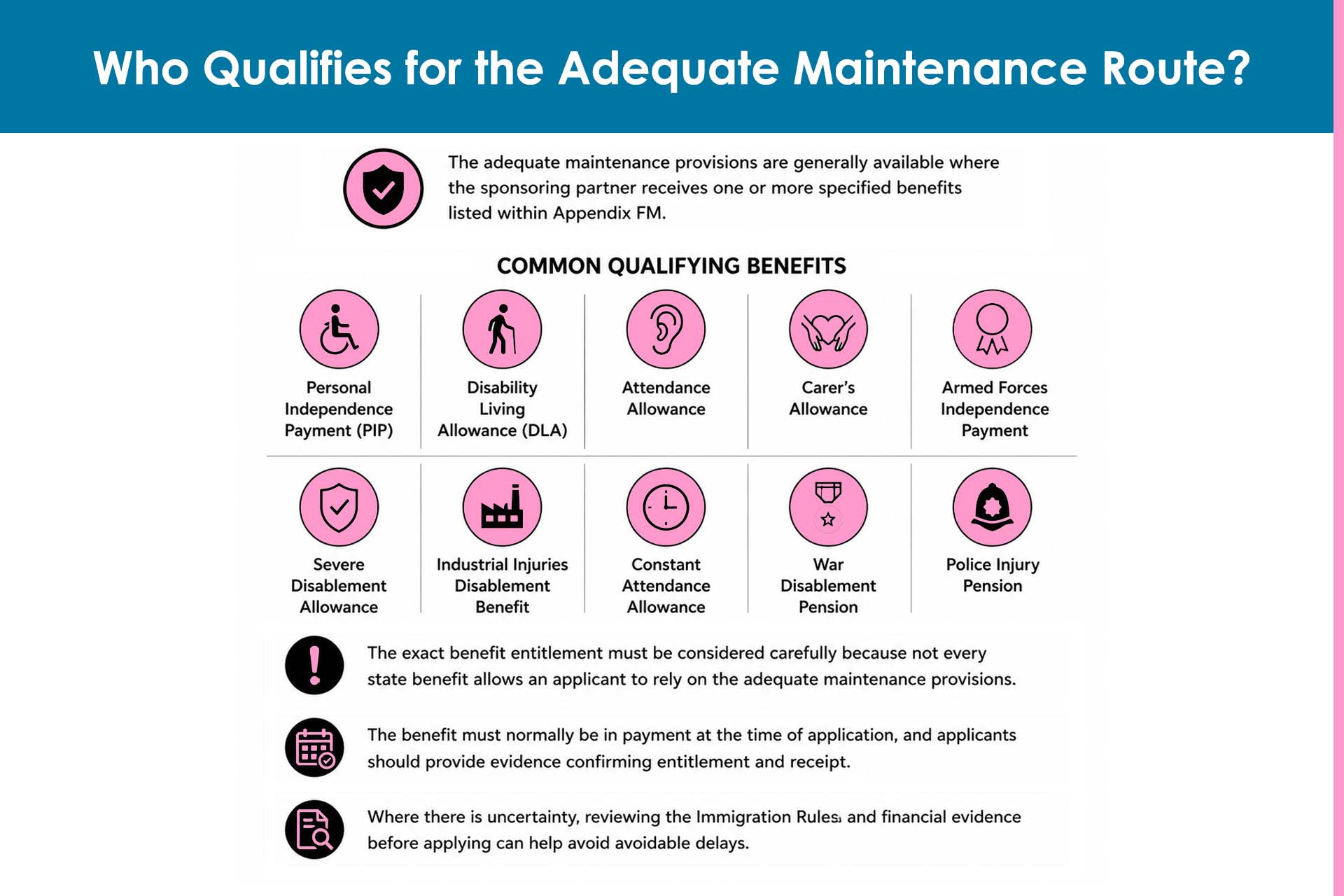
The adequate maintenance provisions are generally available where the sponsoring partner receives one or more specified benefits listed within Appendix FM.
Common qualifying benefits include:
- Personal Independence Payment (PIP)
- Disability Living Allowance (DLA)
- Attendance Allowance
- Carer’s Allowance
- Armed Forces Independence Payment
- Severe Disablement Allowance
- Industrial Injuries Disablement Benefit
- Constant Attendance Allowance
- War Disablement Pension
- Police Injury Pension
The exact benefit entitlement must be considered carefully because not every state benefit allows an applicant to rely on the adequate maintenance provisions.
The benefit must normally be in payment at the time of application, and applicants should provide evidence confirming entitlement and receipt. Where there is uncertainty, reviewing the Immigration Rules and financial evidence before applying can help avoid avoidable delays.
Do I Need to Meet the £29,000 Spouse Visa Financial Requirement?
Usually, no, if the adequate maintenance provisions apply.
The standard spouse visa financial requirement requires the applicant to meet the minimum income threshold. However, where the sponsoring partner receives certain specified benefits, the application is assessed differently.
Instead of asking:
“Does the sponsor earn £29,000 per year?”
UKVI asks:
“After deducting housing costs, does the household have sufficient weekly income to maintain itself at a level comparable to a British family receiving Income Support?”
This means some applicants who would not meet the standard financial requirement may still qualify under the adequate maintenance route. It is important to identify the correct route before preparing the application because using the wrong financial assessment can lead to refusal.
How Is Adequate Maintenance Calculated?
The adequate maintenance calculation is different from the standard spouse visa financial requirement.
The calculation is based on three key figures:
A − B ≥ C
Where:
A = Total weekly net income
This is the household’s total available weekly income after deductions such as Income Tax and National Insurance.
Depending on the circumstances, this may include:
- Qualifying benefits
- Employment income
- Self-employment income
- Pension income
- Rental income
- Cash savings
- Other permitted sources of income under the Immigration Rules
The income relied upon must be supported by appropriate documentary evidence.
B = Weekly housing costs
Housing costs are deducted because the assessment focuses on the income available to support the family after essential accommodation expenses have been paid.
Depending on the circumstances, housing costs may include:
- Rent payments
- Council Tax where applicable
Living expenses such as food, utilities, transport costs and personal spending are not included in the housing costs.
C = Equivalent Income Support amount
The remaining weekly income is compared against the amount of Income Support that would be available to a British family of the same size and composition.
If:
A − B is equal to or greater than C
the adequate maintenance requirement will generally be satisfied.
Although the formula appears simple, applying it correctly can be complicated because applicants must identify:
- which income can be included;
- which benefits qualify;
- which housing cost is to be deducted; and
- what evidence UKVI requires.
Worked Example of the Adequate Maintenance Calculation
| Calculation | Weekly Amount |
| Employment income | £200 |
| Qualifying benefit income | £120 |
| Total weekly income (A) | £320 |
| Weekly housing costs (B) | £140 |
| Remaining income (A − B) | £180 |
The remaining weekly income is compared with the relevant Income Support equivalent for a family of the same size. If it meets or exceeds that amount, the adequate maintenance requirement will usually be satisfied.
What Income Can Be Included for Adequate Maintenance?
The UKVI may consider several sources of income when assessing whether a family can be adequately maintained.
This will include:
1. Benefits
The relevant benefits will be taken into account.
Where relying on benefits, applicants should provide clear evidence confirming:
- the type of benefit received;
- the amount paid;
- the person receiving the benefit; and
- that the benefit is currently in payment.
Depending on the circumstances, other sources of income can be included:
2. Employment income
Income from employment may be considered where the sponsor can provide the required evidence.
Evidence will include:
- payslips;
- bank statements;
- employment confirmation letters; and
- other documents required by Appendix FM-SE.
3. Self-employment income
Self-employed sponsors may also rely on qualifying income where the relevant requirements are met.
Evidence will include:
- business accounts;
- tax returns;
- Invoices/receipts;
- HMRC records;
- accountant confirmation where appropriate;
- other documents required by Appendix FM-SE.
Self-employment cases often require additional preparation because documentation requirements are much more detailed.
4. Other qualifying income
In some circumstances, other income sources may be relevant, including:
- rental income;
- cash savings held for at least 6 months; and
- other income permitted under the Immigration Rules.
The key issue is not simply whether money is being received, applicants must demonstrate that the income qualifies under the rules and that it is properly evidenced.
Which Benefits Qualify for the Adequate Maintenance Route?
Not every benefit received by a sponsor allows an applicant to rely on adequate maintenance. The Immigration Rules identify specific benefits that can bring an application within this route.
Common examples include:
- Personal Independence Payment (PIP)
- Disability Living Allowance (DLA)
- Attendance Allowance
- Carer’s Allowance
- Armed Forces Independence Payment
The sponsor must be in receipt of the benefit prior to submission of the application.
Applicants should provide evidence such as:
- benefit award letters;
- official correspondence confirming entitlement;
- bank statements;
- payment records; and
- any other relevant financial documents.
A frequent mistake is assuming that any benefit payment automatically qualifies. Before applying, applicants should confirm that the specific benefit received falls within the categories recognised under Appendix FM.
What Evidence Is Required Under Appendix FM-SE?
Meeting the adequate maintenance calculation is only one part of the financial assessment. Applicants must also provide the correct documentary evidence required by Appendix FM-SE of the Immigration Rules.
Appendix FM-SE sets out the specified evidence requirements for different types of income relied upon in family visa applications.
UKVI does not simply accept that an applicant has sufficient funds. The financial position must be demonstrated through reliable and consistent documentation.
Depending on the circumstances, evidence may include:
- benefit award letters;
- corresponding bank statements;
- recent payslips;
- employer letters;
- pension statements;
- bank statements showing cash savings;
- self-employment records;
- HMRC documents; and
- other supporting financial records.
The exact evidence required depends on the source of income being relied upon.
For example, a sponsor relying only on income from benefits will need different evidence from a sponsor relying on income both from benefits and employment.
Why Is Appendix FM-SE Important for Adequate Maintenance Applications?
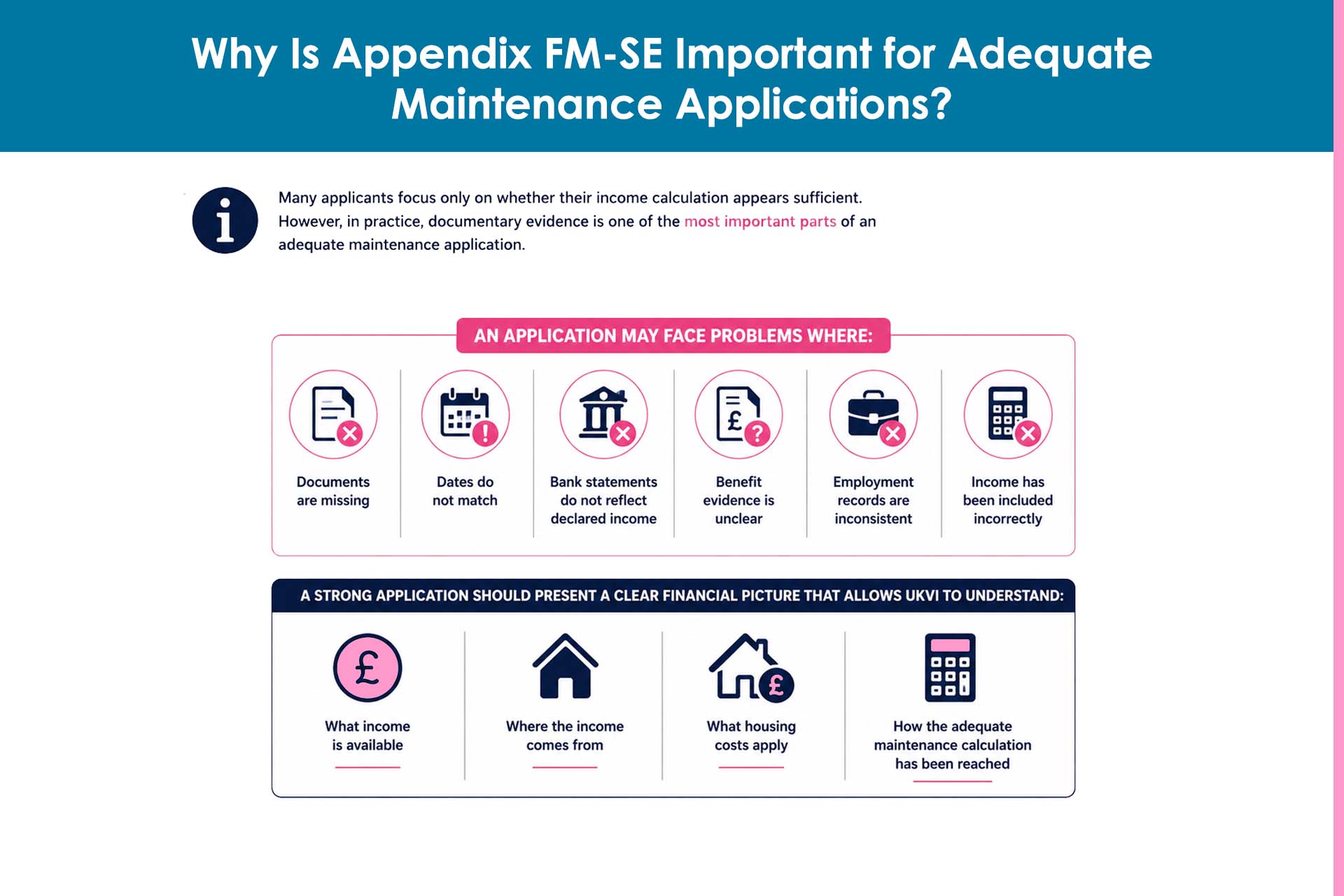
Many applicants focus only on whether their income calculation appears sufficient. However, in practice, documentary evidence is one of the most important parts of an adequate maintenance application.
An application may face problems where:
- documents are missing;
- dates do not match;
- bank statements do not reflect declared income;
- benefit evidence is unclear;
- employment records are inconsistent; or
- income has been included incorrectly.
A strong application should present a clear financial picture that allows UKVI to understand:
- what income is available;
- where the income comes from;
- what housing costs apply; and
- how the adequate maintenance calculation has been reached.
For further guidance on preparing a family visa application, read our article on UK spouse visa document requirements.
What Does the Case Law Say About Adequate Maintenance?
The UKVI’s approach to adequate maintenance has been shaped by decisions of the immigration tribunals. Two of the most important cases explain how the financial assessment should be carried out.
KA (Pakistan)
In KA and Others (Adequacy of Maintenance) Pakistan [2006] UKAIT 00065, the Tribunal confirmed that ‘adequate’ and ‘adequately’ in relation to a maintenance and accommodation requirement shall mean that, after income tax, National Insurance contributions and housing costs have been deducted, there must be available to the family the level of income that would be available to them if the family was in receipt of Income Support.
Ahmed (Bangladesh)
In Ahmed (benefits; proof of receipt; evidence) Bangladesh [2013] UKUT 84 (IAC), the Tribunal provided the formula for assessing adequate maintenance:
A – B ≥ C
A − B is equal to or greater than C
Common Mistakes That Can Lead to Adequate Maintenance Refusal
Adequate maintenance applications are often refused because of lack of relevant financial evidence and incorrect calculations.
Common mistakes include:
1. Using the wrong financial test
One of the most common error is assuming that receiving benefits automatically removes the need for a financial assessment.
The correct route depends on the sponsor’s circumstances and the specific benefit received.
2. Relying on a benefit that does not qualify
Not every benefit allows an applicant to rely on adequate maintenance. Applicants should confirm that the benefit received falls within the categories recognised by Appendix FM before submitting an application.
3. Failing to provide benefit evidence
A benefit payment shown on a bank statement will not be enough. Applicants should provide official evidence confirming entitlement and receipt of the relevant benefit.
4. Incorrectly calculating housing costs
Housing costs are a central part of the adequate maintenance calculation. Errors can occur where applicants:
- fail to include relevant housing costs; or
- calculate weekly costs incorrectly.
5. Providing inconsistent financial documents
UKVI may question applications where financial evidence does not match.
Examples include:
- unclear benefit payments; or
- missing supporting documents.
6. Assuming online calculators are always accurate
Online calculators can be useful as a starting point, but they may not reflect the latest Immigration Rules or the specific circumstances of an individual application.
The correct calculation depends on:
- family size;
- income sources;
- benefit entitlement;
- housing costs
Frequently Asked Questions About Adequate Maintenance
1. How do I know if the adequate maintenance rules apply to me?
The adequate maintenance provisions generally apply where the sponsoring partner receives certain specified benefits recognised under Appendix FM, such as Personal Independence Payment (PIP), Disability Living Allowance (DLA) or Carer’s Allowance.
If the sponsor does not receive a qualifying benefit, the application will normally need to meet the standard UK spouse visa financial requirement instead.
2. Does PIP exempt me from the £29,000 spouse visa financial requirement?
If your partner receives Personal Independence Payment (PIP) or another qualifying benefit listed under Appendix FM, your application may be assessed under the adequate maintenance rules instead of the standard £29,000 minimum income requirement.
You must still meet the other spouse visa requirements and provide evidence showing that the adequate maintenance test is satisfied.
3. Can I apply for a spouse visa if my partner receives disability benefits?
Yes, it may be possible.
Where your British or settled partner receives a qualifying disability or carer-related benefit, you may be able to rely on the adequate maintenance route rather than the standard financial requirement.
The outcome will depend on the specific benefit received, your financial circumstances and the evidence provided.
4. How is adequate maintenance calculated for a spouse visa?
Adequate maintenance is calculated by deducting relevant housing costs from the household’s weekly income.
The remaining amount is then compared with the relevant Income Support equivalent for a family of the same size.
The formula for the calculation is:
A − B ≥ C
Where:
- A is the household’s weekly net income.
- B is weekly housing costs.
- C is the relevant Income Support equivalent.
5. Can I combine employment income with benefits for adequate maintenance?
Yes, depending on your circumstances.
Employment income, qualifying benefits and other permitted sources of income may be considered together when assessing whether the adequate maintenance requirement is met. All income relied upon must be supported by the correct documentary evidence.
6. Can savings be used for adequate maintenance?
Yes, cash savings can be combined with the qualifying benefits but will depend on the individual circumstances.
7. Does rent affect the adequate maintenance calculation?
Yes, housing costs, including rent and council tax (where applicable), are deducted from the household’s income before the remaining amount is compared with the relevant Income Support equivalent. Applicants should ensure housing costs are calculated correctly and supported by evidence.
8. What happens if my adequate maintenance calculation is not sufficient?
If the household income after deduction of housing costs is below the required level, the adequate maintenance requirement is unlikely to be met. Before submitting an application, it is important to review whether all qualifying income has been included and whether the correct calculation has been done.
How Immigration Lawyers at Mulgrave Law Can Help With Adequate Maintenance Applications
Understanding whether the adequate maintenance provisions apply to your circumstances can be challenging, particularly where an application involves specified benefits and additional sources of income.
At Mulgrave Law, our immigration lawyers and solicitors assist clients with complex UK spouse visa and partner visa applications by providing clear advice tailored to their individual circumstances.
We can help with:
- Assessing whether the adequate maintenance route applies to your application.
- Reviewing your financial circumstances against the requirements of Appendix FM.
- Calculating whether your household income meets the adequate maintenance requirement.
- Reviewing financial documents before submission.
- Advising on Appendix FM-SE evidence requirements.
- Assisting applicants relying on PIP, disability benefits or carer-related benefits.
- Preparing spouse visa and partner visa applications.
- Advising where an application has previously been refused.
Every family’s circumstances are different. A careful review of your financial position and supporting documents before applying can help identify potential issues and ensure your application is prepared correctly.
If you need advice about whether you can apply for a UK spouse visa using the adequate maintenance route, contact Mulgrave Law to discuss your circumstances with an immigration lawyer.
- Phone: +44 20 7253 7248
- Email: info@mulgravelaw.co.uk
- Contact form
Final Thoughts: Adequate Maintenance Under Appendix FM
The adequate maintenance provisions provide an important alternative financial assessment for certain UK spouse visa and partner visa applications where the sponsoring partner receives specified benefits.
Unlike the standard £29,000 spouse visa financial requirement, the adequate maintenance route does not rely on a fixed annual income threshold.
Instead, UKVI considers whether the household receiving specified benefits after deduction of relevant housing costs has income equal to or higher than the relevant Income Support equivalent for a family of the same size and circumstances.
Although the calculation may appear straightforward, successful applications require careful attention to:
- which income sources can be included;
- how housing costs are calculated;
- whether the benefit received qualifies; and
- whether the supporting evidence meets Appendix FM-SE requirements.
Understanding the rules before applying and preparing the correct evidence can help reduce the risk of avoidable delays or refusal.