

To qualify for a UK spouse visa in 2026, you will usually need to show that you and your partner meet the minimum gross annual income requirement of £29,000, or that you satisfy the financial requirement through eligible cash savings or a combination of qualifying income sources.
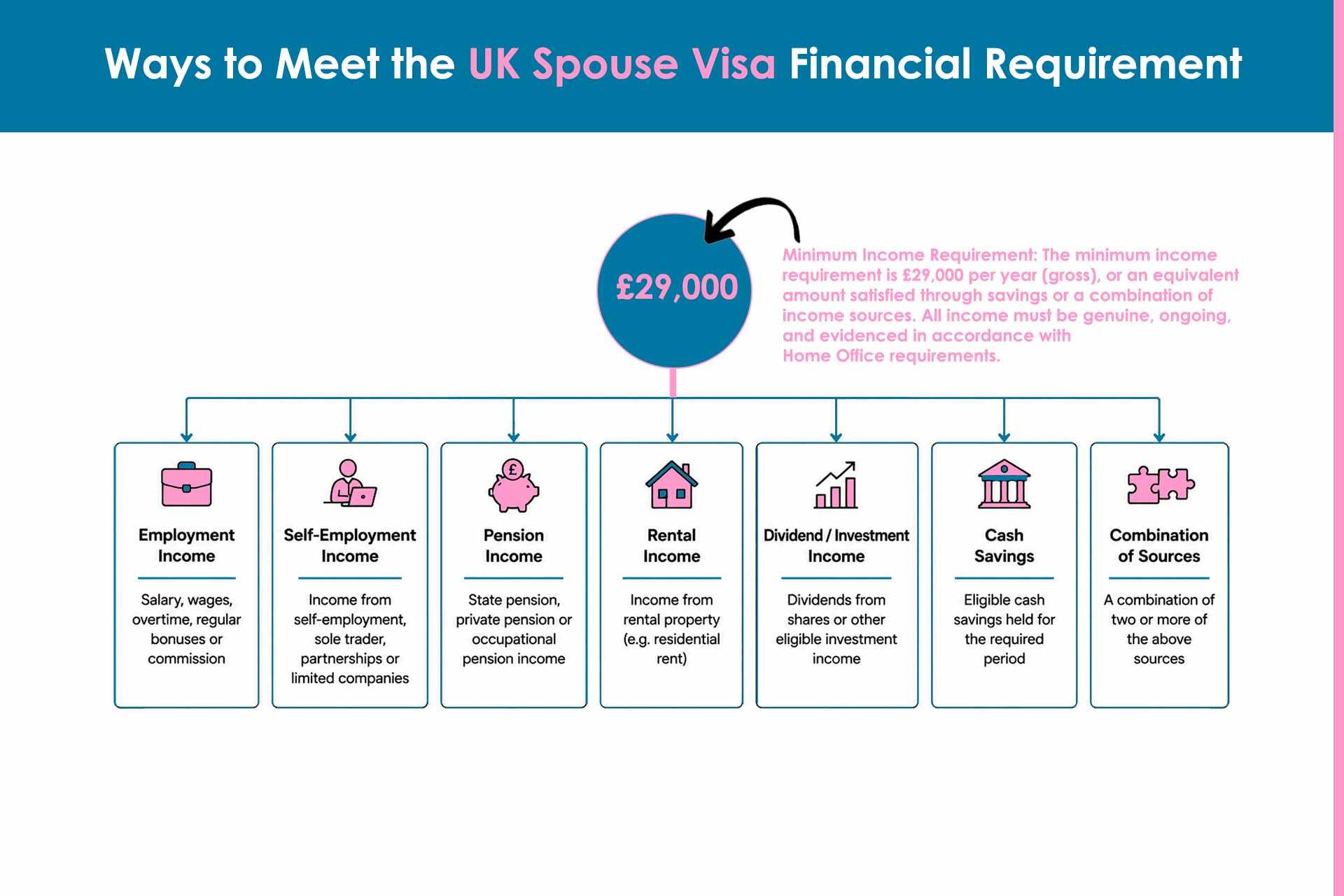
Income can come from employment, self-employment, pensions, rental income, dividends and, in some circumstances, cash savings. Every source of income must meet strict Home Office rules and be supported by the correct evidence.
What Is the UK Spouse Visa Financial Requirement?
The financial requirement is one of the key eligibility criteria for a UK spouse visa. It exists to demonstrate that a couple can support themselves financially without relying on public funds after arriving or remaining in the UK.
The requirement forms part of the UK’s Immigration Rules and applies to most applications made under Appendix FM.
In practice, meeting the financial requirement is not simply about earning enough money. The Home Office will also assess where your income comes from, whether it is genuine, and whether it has been evidenced correctly.
This means two applicants earning the same salary may receive different outcomes if one has provided incomplete or incorrect financial evidence.
What Is the Minimum Income Requirement for a UK Spouse Visa in 2026?
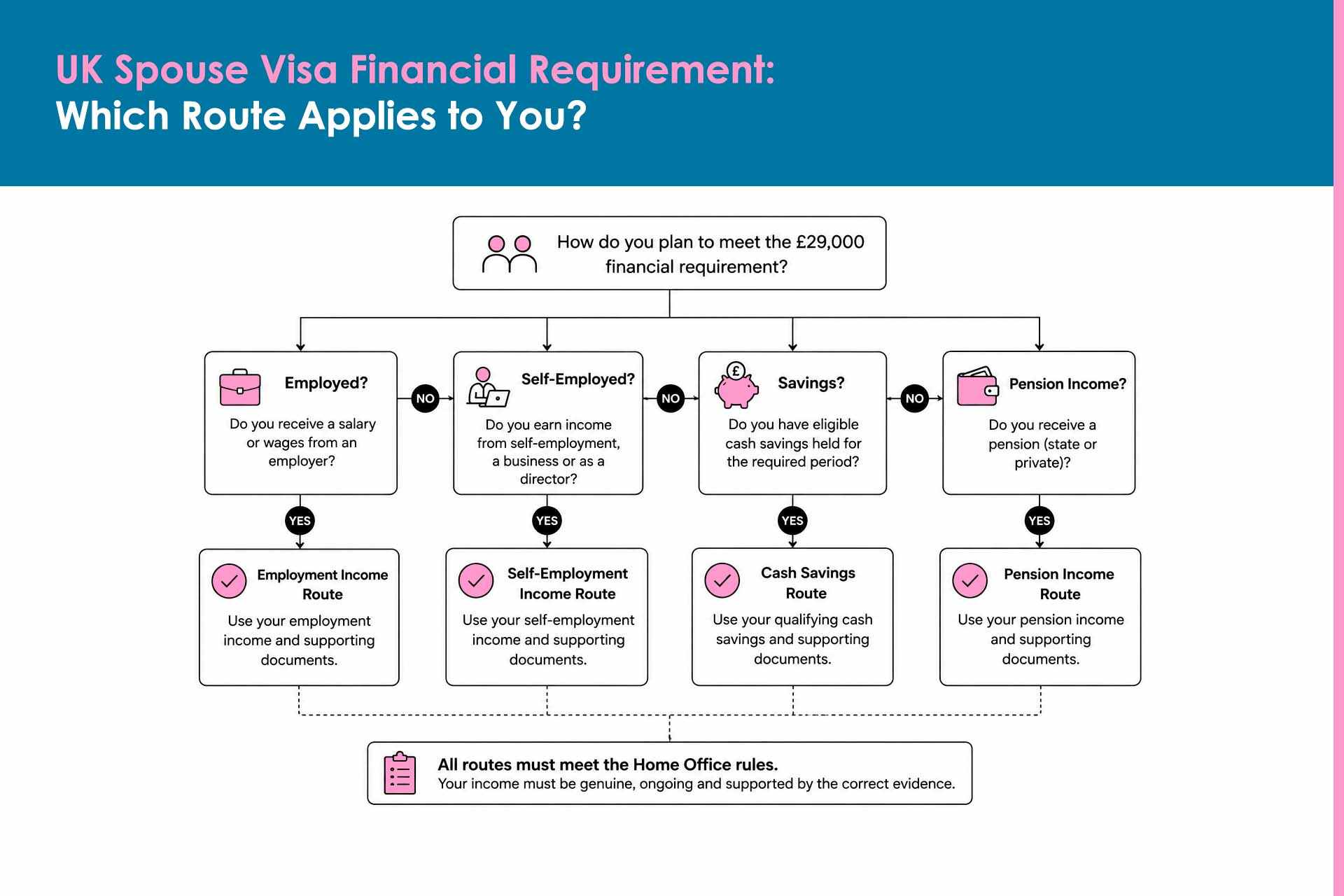
The minimum income requirement for most UK spouse visa applications is £29,000 per year before tax.
This threshold generally applies whether you are:
- Applying from outside the UK
- Extending a spouse visa
- Switching into the spouse visa route from another eligible visa
Immigration rules relating to financial requirements may change over time. Before submitting an application, applicants should always ensure they are relying on the latest published guidance, seeking legal guidance is often the best policy, and meeting the income threshold is only one part of the assessment. Applicants must also prove that the income satisfies the Home Office’s evidential requirements.
What Income Counts Towards the UK Spouse Visa Financial Requirement?
The Home Office accepts several different types of income, provided they meet the Immigration Rules and are supported by appropriate evidence.
Depending on your circumstances, you may be able to rely on one or more of the following:
- Employment income
- Self-employment income
- Pension income
- Rental income
- Dividend income
- Certain other non-employment income
- Cash savings
Many successful applications rely on a combination of qualifying income sources rather than a single salary.
1. Employment Income
Employment income is the most common way applicants meet the financial requirement.
This includes:
- Full-time employment
- Part-time employment
- Permanent employment
- Fixed-term contracts
- Regular overtime
- Contractual bonuses
- Certain commission payments
The Home Office will normally expect evidence such as:
- Payslips
- Corresponding bank statements
- An employer’s letter confirming your employment
- Information about your salary and length of employment
Example: Meeting the Financial Requirement Through Employment
Emma has worked for the same employer for three years and earns £31,500 annually. She provides six months of payslips, six months of matching bank statements and an employer letter confirming her employment.
Provided the documents are consistent, she is likely to satisfy the financial requirement through employment income alone.
2. Self-Employment Income
Self-employed applications are often more complex because income can fluctuate throughout the financial year.
Applicants may include income from:
- Sole traders
- Partnerships
- Limited company directors
- Freelancers
- Contractors
Depending on the category relied upon, supporting evidence may include:
- SA302 tax calculations
- HMRC tax year overviews
- Business accounts
- Accountant’s certificates
- Company documents
- Business bank statements
One of the most common issues we see is applicants assuming that business turnover is the same as personal income. The Home Office is interested in qualifying income rather than overall business revenue.
3. Pension Income
Certain pensions may also count towards the financial requirement.
Examples include:
- State Pension
- Occupational Pension
- Private Pension
Applicants should ensure they provide documentation showing both the amount received and that the payments are ongoing.
For retired sponsors, pension income can often provide a straightforward route to meeting the financial requirement when supported by the correct evidence.
4. Rental Income and Other Non-Employment Income
Income generated from property or investments may also be taken into account.
Examples include:
- Rental income from residential property
- Dividend income
- Certain investment income
- Interest from savings (where permitted under the rules)
Applicants must demonstrate ownership of the relevant assets together with evidence that the income has genuinely been received.
For rental income, this may include tenancy agreements together with corresponding bank statements showing rental payments.
Can You Use Cash Savings Instead of Income?
Yes. In some circumstances, cash savings can be used either on their own or alongside other qualifying income sources to meet the financial requirement.
However, strict rules apply.
Generally speaking, savings must:
- Be immediately accessible
- Have been held for the required period
- Be under the control of the applicant, sponsor or both
- Meet the Home Office’s evidential requirements
The calculation of cash savings is one of the most misunderstood areas of spouse visa applications.
Read our dedicated guide Using Cash Savings to Meet the UK Spouse Visa Financial Requirement explaining how cash savings are assessed, how much may be required and the evidence applicants should provide.
Can You Combine Different Sources of Income?
Yes. Many applicants meet the financial requirement by combining more than one eligible income source.
For example:
- Employment income and rental income
- Employment income and cash savings
- Pension income and investment income
- Self-employment income and savings
The rules governing how income can be combined vary depending on the category relied upon.
An incorrect calculation may lead to an otherwise avoidable refusal.
For applicants whose financial circumstances are more complicated, obtaining legal advice before submitting an application can help ensure that the correct income categories have been used.
Which Income Cannot Usually Be Used?
One area that often causes confusion is assuming that all money available to a couple automatically counts towards the financial requirement.
In reality, certain assets and funds cannot normally be relied upon.
These include:
- Property value that has not been converted into cash
- Borrowed money or personal loans
- Expected inheritances
- Future salary increases
- Prospective bonuses that have not yet been paid
- Investments that do not satisfy the Immigration Rules
Understanding what cannot be used is just as important as understanding what can.
Many refusals occur because applicants incorrectly assume that assets with substantial value automatically satisfy the financial requirement.
What Financial Documents Do You Need for a UK Spouse Visa?
The Home Office requires more than proof that you meet the financial threshold. You must also provide documentary evidence in the correct format to demonstrate that your income is genuine and meets the Immigration Rules.
The documents required will depend on the type of income you are relying on, but commonly include:
| Income Type | Typical Supporting Documents |
| Employment | Payslips, corresponding bank statements, employer letter |
| Self-employment | SA302s, HMRC Tax Year Overview, business accounts, accountant’s letter |
| Pension | Pension statements and evidence of payments |
| Rental income | Tenancy agreement, proof of ownership, bank statements showing rental payments |
| Cash savings | Bank statements showing the required balance over the relevant period |
It is not enough simply to provide the documents. They must be consistent with one another. For example, the salary shown on your payslips should correspond with the deposits appearing on your bank statements, and the information in your employer’s letter should match both.
Do Different Financial Rules Apply to Self-Employed Applicants?
Yes. Self-employed applications are generally more document-intensive than applications relying solely on employment income.
Unlike salaried employees, self-employed applicants often need to demonstrate their income over an entire financial year and provide supporting business documentation.
Depending on your circumstances, the Home Office may require:
- Tax calculations (SA302s)
- HMRC Tax Year Overviews
- Business accounts
- Accountant certification
- Company documents
- Business bank statements
If you are a director of a limited company, different evidential rules may apply. It is therefore important to ensure you are relying on the correct income category before submitting your application.
Are There Any Exemptions to the Financial Requirement?
Not every applicant is required to satisfy the standard minimum income threshold.
Certain applicants whose sponsor receives specific benefits may instead be assessed under the adequate maintenance test.
Examples of qualifying benefits may include:
- Personal Independence Payment (PIP)
- Disability Living Allowance (DLA)
- Attendance Allowance
- Carer’s Allowance
- Armed Forces Independence Payment
What is the Adequate Maintenance Test?
The adequate maintenance test is a financial assessment used by UK Visas and Immigration (UKVI) in certain family visa applications, such as Spouse or Partner visas. It may be used as an alternative to the standard £29,000 minimum income requirement where the UK sponsor receives specified state benefits, including disability or carer-related benefits.
It is assessed under a different framework from the standard financial requirement and requires separate supporting evidence.
Where an exemption may apply, applicants should seek legal advice before submitting an application.
Why Are UK Spouse Visa Applications Refused for Financial Reasons?
Meeting the income threshold alone does not guarantee a successful application.
Financial refusals often occur because applicants misunderstand the Home Office’s documentary requirements rather than because they genuinely fail to meet the threshold.
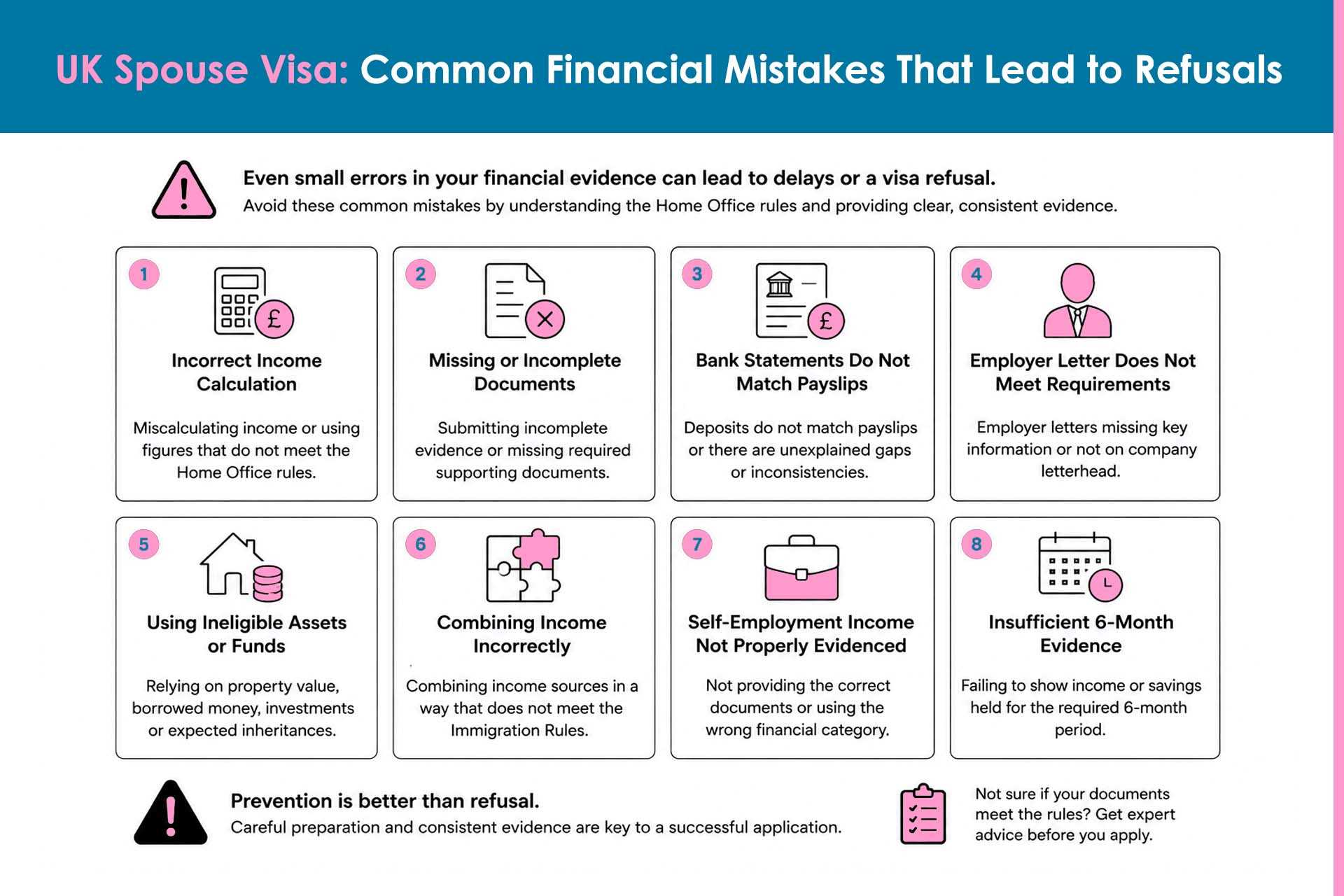
Some of the most common reasons include:
- Incorrect financial calculations
- Missing or incomplete supporting documents
- Bank statements that do not correspond with payslips
- Employer letters missing mandatory information
- Using assets that do not qualify under the Immigration Rules
- Relying on the wrong financial category
- Failing to evidence self-employment income correctly
Many of these issues are entirely avoidable with careful preparation before an application is submitted.
How Does the Home Office Assess Financial Evidence?
When considering your application, the Home Office is not simply checking whether you earn enough money.
Caseworkers will assess whether:
- The income is genuine.
- The income falls within an accepted category under the Immigration Rules.
- The supporting documents satisfy the evidential requirements.
- The income appears likely to continue after the application.
- The financial evidence is internally consistent.
For this reason, accuracy is often just as important as the level of income itself.
Frequently Asked Questions: UK Spouse Visa Financial Requirement
1. Can I apply if I earn less than £29,000?
Possibly. Depending on your circumstances, you may be able to combine eligible income sources or rely on qualifying cash savings. Every case is different, and the calculation depends on the relevant financial category.
2. Can I combine salary and savings?
Yes. In many cases, qualifying cash savings can be combined with employment income to help satisfy the financial requirement, provided the Home Office’s calculation rules are met.
3. Can I use my overseas income?
This depends on your circumstances and where the application is being made. In some situations, overseas income may be relevant, but applicants should not assume that all foreign earnings will automatically qualify.
4. Can I rely on property instead of savings?
Not usually. The value of a property cannot normally be counted unless it has first been converted into qualifying cash savings in accordance with the Immigration Rules.
5. Can I use money borrowed from family or friends?
No. Borrowed funds generally do not satisfy the financial requirement because they are not treated as qualifying cash savings.
6. What happens if my application is refused?
The appropriate next step will depend on the reason for refusal. In some cases, it may be possible to submit a fresh application with corrected evidence. In others, an appeal or another legal remedy may be available.
UK Spouse Visa Financial Requirement: Mulgrave Law legal insight
In practice, the financial requirement under Appendix FM is not assessed as a simple income threshold exercise. Caseworkers apply a strict evidential framework, and refusals frequently arise where applicants fail to align their documentation with the relevant category of income rather than from an actual shortfall in earnings. A common issue is inconsistent financial evidence—particularly discrepancies between payslips, bank statements, and employer confirmations—which can lead to credibility concerns and refusal under E-ECP.3.1 or Appendix FM-SE evidential requirements.
The Home Office will also scrutinise whether income is genuinely “specified” and “continuing”, particularly in self-employment and variable income cases. Applicants often underestimate the importance of correct categorisation under Appendix FM-SE, which determines not only what income can be counted, but how it must be calculated and evidenced. Even financially strong applicants can be refused where the evidential rules are not met in full.
How Immigration Solicitors at Mulgrave Law Can Help
Preparing the financial evidence for a spouse visa application can be one of the most challenging parts of the process.
Whether you are relying on employment income, self-employment, rental income or cash savings, ensuring that the correct documents are provided in the correct format is essential.
At Mulgrave Law, we regularly assist clients with:
- Assessing whether they meet the financial requirement
- Calculating income under the Immigration Rules
- Reviewing supporting financial evidence before submission
- Advising on self-employed and company director applications
- Preparing fresh applications following previous refusals
- Supporting complex financial circumstances
Obtaining advice before applying can often prevent avoidable delays and reduce the risk of refusal. Book a consultation with our team today.
- Phone: +44 20 7253 7248
- Email: info@mulgravelaw.co.uk
- Contact form