

Key Points at a Glance
You may qualify for a UK Spouse Visa if you meet the relevant requirements of the Immigration Rules, but being married to a British citizen or person settled in the UK does not automatically guarantee eligibility.
Common issues that can affect eligibility include:
- the sponsor not having the required immigration status;
- financial evidence not meeting the Immigration Rules;
- insufficient relationship evidence;
- switching from an immigration category which does not allow an in-country switch; or
- previous immigration history affecting suitability.
Identifying potential issues before applying can help avoid delays, additional costs and the risk of refusal.
Remember: Meeting one requirement does not automatically mean you qualify for a UK Spouse Visa. The Home Office assesses every application against the relevant Immigration Rules, considering factors such as sponsorship, finances, relationship requirements, suitability and supporting evidence as a whole.
Do you qualify for a UK Spouse Visa?
A UK Spouse Visa allows eligible applicants to join their spouse or partner in the UK and continue their family life together. However, eligibility depends on meeting the specific requirements set out in the Immigration Rules, rather than simply being married to someone who lives in the UK.
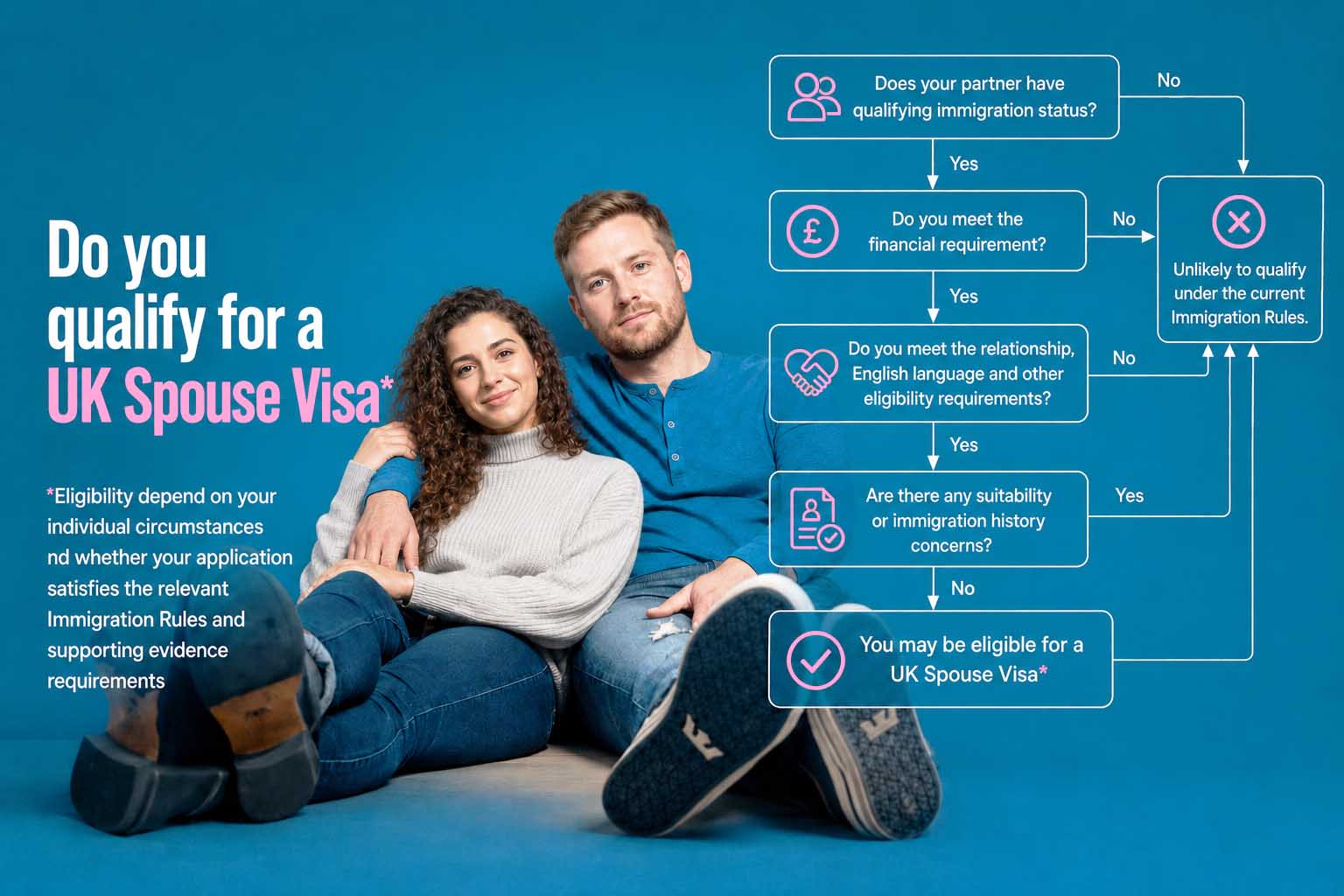
When considering a Spouse Visa application, the Home Office will assess whether the applicant satisfies all relevant requirements, including:
- whether the sponsoring partner has the necessary immigration status;
- whether the financial requirement is met through an accepted source of income or savings;
- whether the relationship meets the requirements of the family visa rules and is genuine and subsisting;
- whether the applicant meets the English language requirement or qualifies for an exemption;
- whether the application is being made under the correct route and from the correct location; and
- whether any suitability concerns, including previous immigration history, affect the application.
Many applicants only discover potential difficulties after they have started preparing their application. For example, a sponsor may earn above the minimum threshold, but the income may not be counted under the correct category, or a couple in a genuine relationship have insufficient evidence to demonstrate this clearly to the Home Office.
A successful application requires more than meeting the basic eligibility criteria. Applicants must also provide evidence that satisfies the Immigration Rules and addresses any potential concerns before submitting their application.
In this guide, we examine 10 common reasons why an applicant’s eligibility may be affected for a UK Spouse Visa in 2026 and explain what you should consider if any of these issues apply to your circumstances.
1. Your partner may not have the required status to sponsor your UK Spouse Visa application
Before considering financial evidence, relationship documents or supporting information, the first step is to establish whether your partner is eligible to sponsor a UK Spouse Visa application.
A common misconception is that anyone who lives in the UK can sponsor their spouse or partner. However, under the Immigration Rules, the sponsoring partner must hold a qualifying status that permits them to sponsor a family visa application.
This may include a person who is:
- a British citizen;
- an Irish citizen;
- settled in the UK, such as a person with Indefinite Leave to Remain;
- a person with qualifying status under the EU Settlement Scheme; or
- someone with another form of immigration permission that allows sponsorship under the relevant rules.
The specific requirements depend on the sponsor’s individual circumstances and immigration status. A person’s residence in the UK alone does not determine whether they can sponsor a Spouse Visa application. The Home Office will first consider whether the sponsor falls within an eligible category before assessing the remaining requirements of the application.
Before preparing evidence or submitting an application, applicants should confirm:
Does the sponsoring partner have the correct immigration status to sponsor the application?
Establishing this at the outset helps ensure that the application is made under the correct route and avoids unnecessary preparation where the fundamental sponsorship requirement is not met.
2. You may not meet the financial requirement
The financial requirement is one of the most important eligibility criteria for a UK Spouse Visa application. In most cases, the sponsoring partner must demonstrate that they meet the minimum income threshold set by the Immigration Rules, which is currently £29,000 per year.
However, satisfying the financial requirement is not simply a question of earning above the required amount. The Home Office applies specific rules regarding which sources of income can be relied upon, how income is calculated, and what documentary evidence must be provided.
Potential issues can arise where:
- the sponsor has recently started a new job;
- income is variable or not received in a regular pattern;
- the sponsor is self-employed;
- the sponsor is a director of a limited company;
- income from multiple sources is being combined;
- bonuses, commission or overtime form part of the income relied upon; or
- the applicant intends to rely on savings.
A common mistake is assuming that a sufficient income level automatically means the financial requirement has been met. In reality, the Home Office must be satisfied that the income falls within an accepted category under the Immigration Rules and that the required evidence has been provided.
A successful application therefore requires both:
- the correct financial category; and
- evidence that clearly demonstrates the requirement is satisfied.
Where financial circumstances are complex, understanding the rules before applying is essential to avoid relying on income or documents that may not be accepted.
For a detailed explanation of the financial requirements, see our guide: UK Spouse Visa Financial Requirement Explained (2026 Complete Guide)
3. Your income may not be treated in the way you expect
Meeting the minimum income threshold is only part of the financial assessment. The Immigration Rules prescribe specific categories of income that may be relied upon, and the way income is assessed depends on the source of that income and the sponsor’s circumstances.
The Home Office does not simply consider the total amount of money available. It must be satisfied that the income being relied upon falls within an accepted category and that the relevant requirements for that category have been met.
This can be particularly important where the sponsor relies on:
- self-employment income;
- income from a limited company;
- variable or irregular earnings;
- a recent change of employment;
- income earned overseas; or
- a combination of different types of income.
Different financial categories are subject to different rules governing how income is calculated and what documentary evidence is required. In some cases, the distinction between salary, dividends, self-employment income or other sources of earnings can materially affect whether the financial requirement is satisfied.
This means that the sponsor cannot necessarily combine all income simply because the total amount exceeds the minimum threshold. The relevant Immigration Rules must be applied to the particular sources of income being relied upon.
A proper assessment should therefore consider:
- the source and nature of the income;
- the financial category under which it is being relied upon;
- how the income must be calculated under the Immigration Rules; and
- whether the required documentary evidence has been provided.
Where income is complex or comes from more than one source, checking the correct financial category before applying is particularly important. An applicant may have sufficient funds overall but still fail to meet the financial requirement if the income has been calculated incorrectly or the evidence does not satisfy the relevant rules.
4. Your savings may not qualify
Cash savings can be used to meet the financial requirement but simply having a substantial balance in a bank account does not automatically mean the requirement is satisfied.
Under the Immigration Rules, the Home Office will consider factors including:
- whether the savings are held in an acceptable form;
- who owns the funds;
- how long the required amount has been held; and
- whether the correct calculation and supporting evidence have been provided.
A common mistake is assuming that money recently transferred into an account, or a large balance held at the time of application, will automatically qualify.
Applicants relying on savings should therefore check the relevant requirements carefully before applying, particularly where funds have been gifted, recently transferred or held in different accounts.
For a detailed explanation of the rules, calculations and evidence required, see our guide: Cash Savings for UK Spouse Visa Applications.
5. You may not meet the English language requirement
Depending on their circumstances, Spouse Visa applicants may need to demonstrate that they meet the English language requirement under the Immigration Rules.
This may involve passing an approved English language test, although some applicants may satisfy the requirement through a relevant qualification, nationality or another permitted exemption.
Applicants should not assume that speaking English fluently automatically satisfies the requirement. The Home Office will consider whether the applicant meets the specific rules that apply to their circumstances and whether the required evidence has been provided.
Before applying, you should establish:
- whether the English language requirement applies to you;
- what level of English is required; and
- what evidence you need to provide.
If the requirement applies and is not met, the application may not qualify under the Immigration Rules.
6. You may be applying under the wrong family visa route
Being married to someone in the UK does not, by itself, guarantee eligibility for a UK Spouse Visa. The Home Office must be satisfied that the relationship meets the requirements of the relevant Immigration Rules and that the couple intends to live together permanently in the UK.
Potential issues can arise where:
- you are engaged but have not yet married;
- you are in a long-term relationship but are not married;
- a marriage took place overseas, and its validity or recognition is unclear; or
- your circumstances may be better suited to another immigration route.
For example, an unmarried couple may need to consider the Unmarried Partner route, while a couple intending to marry in the UK may need to consider a Fiancé Visa before applying as spouses.
Choosing the correct immigration route is essential. Before applying, you should establish whether your relationship and circumstances meet the requirements of the route you intend to use and whether you have the evidence needed to support the application.
7. Your relationship evidence may not be strong enough
The Home Office must be satisfied that the relationship relied upon for a Spouse Visa application is genuine and subsisting. Applicants therefore need to provide evidence that supports the history and continuing genuine nature of their relationship.
The evidence required will depend on the couple’s individual circumstances. A couple who have lived together for several years may have different evidence from those who have maintained a long-distance relationship.
Relevant evidence may include:
- marriage or civil partnership certificate;
- evidence of visits and travel;
- communication records;
- photographs;
- joint financial commitments; and
- evidence of living together or plans to establish a life together in the UK.
The objective is not to provide an excessive volume of documents, but to present relevant and consistent evidence that supports the relationship described in the application. Gaps, inconsistencies or insufficient evidence may lead to further questions about whether the relationship meets the requirements.
See our detailed guide: How to Prove a Genuine and Subsisting Relationship for a UK Spouse Visa Application.
8. You may not be able to apply from inside the UK
Where you make your Spouse Visa application can be an important part of your eligibility.
Some applicants may be permitted to switch into the family route from within the UK, while others must apply from overseas. Being physically present in the UK does not, by itself, give you the right to submit an in-country Spouse Visa application.
For example, a person who is in the UK as a visitor will generally be unable to switch from visitor status to the Spouse Visa route.
Before applying, you should establish:
- what immigration permission you currently hold;
- whether you are permitted to switch into the family route;
- whether you must apply from outside the UK; and
- whether another immigration route is more appropriate.
Applying under the wrong category or from the wrong location can result in an invalid or unsuccessful application and unnecessary additional costs.
9. Your immigration history could affect your application
A previous immigration issue does not automatically prevent you from qualifying for a UK Spouse Visa. However, your immigration history may be relevant to the suitability requirements that apply to your application.
Potential concerns may include:
- previous visa refusals;
- overstaying or breaching immigration conditions;
- providing false or misleading information;
- previous deception findings; or
- criminal convictions.
The nature and circumstances of any previous issue are important. For example, a previous visa refusal based on insufficient evidence is not necessarily treated in the same way as a refusal involving overstay or breach of immigration conditions.
Applicants must also answer questions about their immigration history accurately and disclose relevant previous applications and refusals. Failing to provide complete and truthful information can create additional difficulties and may raise suitability concerns.
If you have previously overstayed, breached immigration conditions, been refused a visa or raised other immigration concerns, it is important to understand the potential impact on your Spouse Visa application before applying.
10. Your accommodation arrangements may not meet the requirements
Accommodation is another area where applicants can be uncertain about what is required for a UK Spouse Visa.
The Immigration Rules require applicants to have adequate accommodation for themselves and their family without relying on public funds. The accommodation must not be overcrowded or contravene public health regulations.
This does not necessarily mean that you must own a property or have a tenancy agreement in your own name. Depending on your circumstances, you may be able to live in rented accommodation, a property owned by your partner, or accommodation provided by family members.
However, the proposed living arrangements should be genuine, suitable for the family and capable of meeting the relevant requirements.
Potential issues can arise where:
- the accommodation is already overcrowded;
- the property is shared with several other people;
- the living arrangements are unclear or not properly explained; or
- the applicant has not considered whether the accommodation meets the relevant requirements.
Applicants should therefore consider their proposed accommodation arrangements before applying and ensure that the evidence provided accurately reflects where they intend to live in the UK.
What if one of these issues applies to you?
Identifying a potential issue does not necessarily mean that you cannot obtain a UK Spouse Visa. In many cases, the problem can be addressed through the correct immigration route, appropriate evidence or careful preparation.
The important thing is to identify potential concerns before submitting your application. This can help reduce the risk of avoidable delays, additional costs or refusal.
Final thoughts: Do you qualify for a UK Spouse Visa?
A UK Spouse Visa application involves more than proving that you are married to someone in the UK.
The Home Office considers a range of requirements, including:
- whether your partner can sponsor you;
- whether the financial requirement is met;
- whether you meet the English language requirement;
- whether your relationship meets the requirements;
- whether your evidence supports your relationship;
- whether you are applying from the correct location; and
- whether previous immigration history affects your application.
Every couple’s circumstances are different.
A situation that is straightforward for one applicant may be more complicated for another because of income sources, relationship circumstances, previous immigration history or available evidence.
If you are unsure whether you qualify, obtaining advice before applying can help you understand your options and avoid common mistakes.
At Mulgrave Law, we advise individuals and couples on UK Spouse Visa applications, including eligibility, financial requirements, relationship evidence and applications from inside or outside the UK.
To discuss your circumstances, contact Mulgrave Law:
- Phone: +44 20 7253 7248
- Email: info@mulgravelaw.co.uk
- Contact form
Frequently asked questions
1. What are the basic requirements for a UK Spouse Visa?
To qualify for a UK Spouse Visa, you must meet the relevant requirements of the Immigration Rules. These generally include having an eligible sponsoring partner, meeting the relationship requirements, satisfying the financial, accommodation and English language requirements where applicable, and meeting the relevant suitability and immigration requirements.
2. What can stop me from qualifying for a UK Spouse Visa?
Common issues include having a sponsor who does not hold the required immigration status, failing to meet the financial requirement, relying on income or savings that do not qualify, insufficient relationship evidence, applying under the wrong immigration route, or having immigration history that raises suitability concerns.
3. Can I apply for a UK Spouse Visa if I do not meet the financial requirement?
It depends on your circumstances. The standard financial requirement may be met through permitted sources of income or savings, while different rules may apply in certain cases involving human rights considerations or exceptional circumstances. You should establish which rules apply to your circumstances before applying.
4. Does my partner have to earn £29,000 for me to qualify for a Spouse Visa?
Not necessarily. The financial requirement can potentially be met through permitted sources other than the sponsor’s employment income, including qualifying cash savings and certain other income. The applicable rules depend on the circumstances and the financial category being relied upon.
5. Can I qualify for a Spouse Visa if my partner is self-employed?
Yes, self-employment income can be relied upon but the Immigration Rules contain specific requirements governing how that income is calculated and evidenced. The documentary requirements differ significantly from those who are employed.
6. Can I qualify for a Spouse Visa if my partner is a company director?
Yes, however, the treatment of income can depend on the structure of the company and whether the sponsor is relying on salary, dividends or other income. The relevant financial category and supporting evidence should be carefully considered before applying.
7. Can I apply for a Spouse Visa if I am not currently living with my partner?
Yes, couples do not necessarily have to be living together at the time of application. However, the Home Office must be satisfied that the relationship is genuine and subsisting and that the couple intend to live together permanently in the UK. The evidence required will depend on the couple’s individual circumstances.
8. Can I apply for a UK Spouse Visa if my partner is not a British citizen?
Potentially, yes. A sponsor does not necessarily have to be a British citizen. Depending on their circumstances, a person with settled status or certain other qualifying immigration status may be able to sponsor a partner under the family visa rules.
9. Can I apply for a Spouse Visa if I am in the UK on another visa?
It depends on your current immigration status. Some applicants may be able to switch into the family route from within the UK, while others must apply from outside the UK. Visitors, for example, will generally be unable to switch into the Spouse Visa route while in the UK.
10. How long do I need to have been married before applying for a UK Spouse Visa?
There is generally no minimum period for which you must have been married before applying. However, you must satisfy the relationship requirements under the Immigration Rules and provide evidence demonstrating that your relationship is genuine and subsisting.
11. Can a previous visa refusal affect my Spouse Visa application?
A previous visa refusal does not automatically prevent you from obtaining a Spouse Visa. However, the reason for the refusal may be relevant, particularly where it involved deception, false information or other suitability concerns. Previous immigration history should be disclosed accurately in your application.
12. Can I apply for a Spouse Visa if I have previously overstayed in the UK?
It depends on the circumstances of the previous overstay and the rules that apply to your application. An immigration breach may raise suitability issues, but the consequences depend on factors including the length and circumstances of the overstay and any applicable exceptions.
13. What happens if my Spouse Visa application is refused?
The appropriate next step depends on the reason for refusal. Depending on the circumstances, you may be able to challenge the decision, make a fresh application or take another legal route. It is important to understand the refusal before deciding what to do next.
Related UK Spouse Visa Reading
- UK Spouse Visa Financial Requirement Explained (2026 Complete Guide)
- Client Success: UK Spouse Visa Approved for Cruise Ship Workers with Offshore Employment
- Client Case Study: UK Spouse Visa Application from the USA: My Story, the Mistakes We Made and Why Getting a Second Opinion Made All the Difference
- What is the Immigration Advice Authority (IAA)? How to choose a regulated UK immigration adviser, Solicitor (2026)